
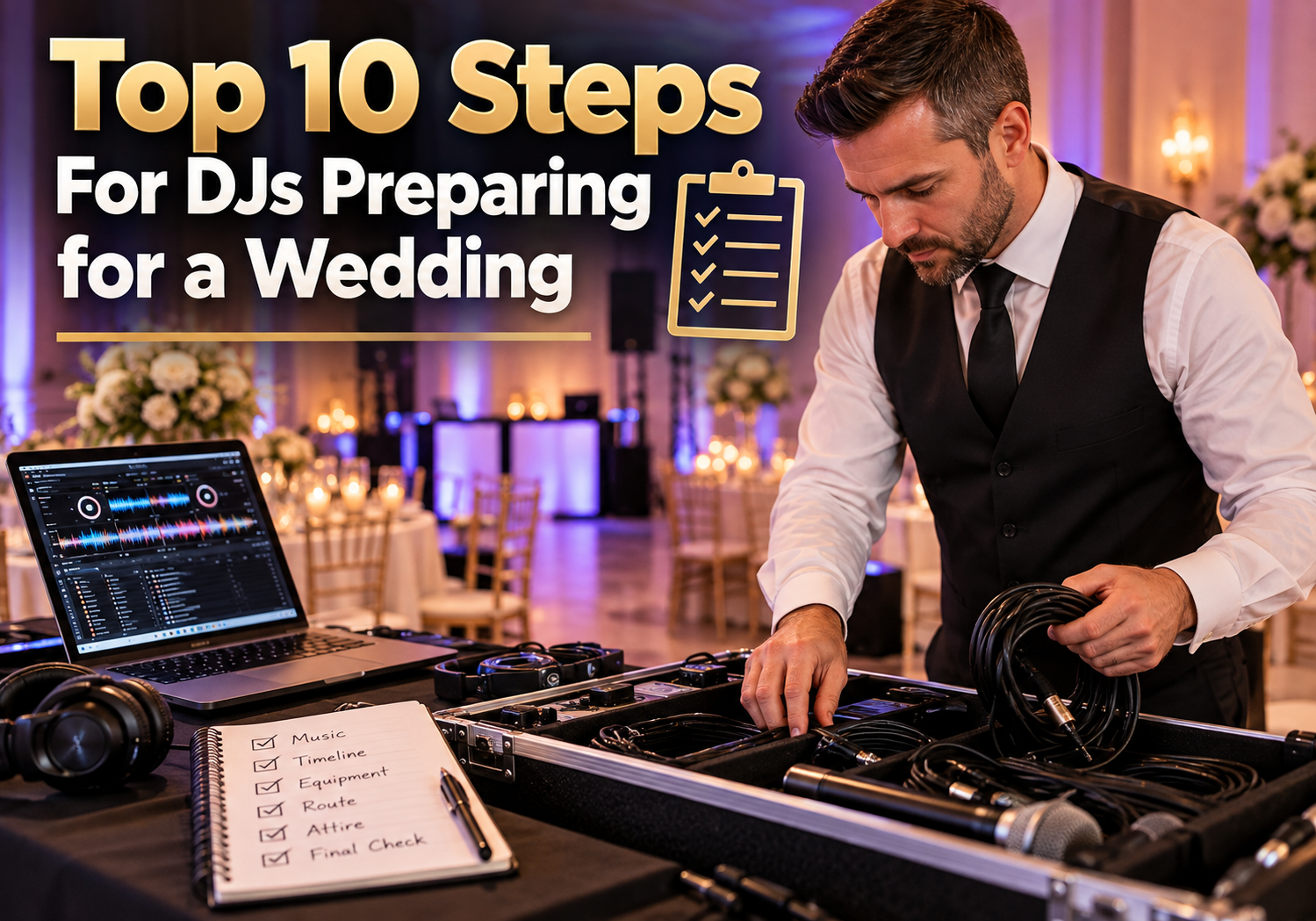
Top 10 Steps For DJs Preparing for a Wedding
Preparing for a wedding requires much more than showing up with speakers, a laptop, and a collection of music. The most successful DJs understand that preparation is the foundation of a smooth, organized, and memorable reception. These Top 10 Steps For DJs Preparing for a Wedding will help you organize your responsibilities, communicate effectively with the couple, and avoid common mistakes that can affect your performance. Whether you are an experienced wedding DJ or just starting in the industry, following a consistent preparation process can help you deliver a better experience for every couple you serve.
A wedding reception involves numerous moving parts, including music requests, formal announcements, vendor coordination, equipment setup, and a carefully planned timeline. Missing even one important detail can create unnecessary stress on the wedding day.
The good news is that most preparation problems can be prevented with a reliable system.
Here are 10 essential steps every wedding DJ should follow before the big day.
Top 10 Steps For DJs Preparing for a Wedding
1. Complete the Questionnaire and Schedule a Wedding DJ Consultation.
One of the most important steps in preparing for a wedding is making sure you understand exactly what the couple wants for their reception.
Start by having the couple complete your wedding DJ questionnaire. This document should collect essential information about the wedding, including the reception timeline, important songs, special dances, wedding party introductions, announcements, and musical preferences.
Your questionnaire should cover details such as:
- The names and pronunciations of the couple.
- The names of the wedding party members.
- The order of the grand entrance.
- The first dance song.
- Father-daughter and mother-son dance selections.
- Cake cutting and bouquet toss songs, if applicable.
- Dinner music preferences.
- Must-play songs and do-not-play songs.
- Special announcements and reception traditions.
- The couple’s preferred music genres.
- Any special requests or surprises planned for the reception.
However, collecting the questionnaire is only the beginning.
Schedule a wedding DJ consultation to review the details with the couple.
A consultation gives you the opportunity to clarify information, discuss the reception timeline, and make sure you understand their expectations. Sometimes couples leave important details out of a questionnaire because they do not realize those details matter to the DJ.
For example, the couple might request a particular song for their grand entrance without explaining how they want the wedding party introduced. A consultation allows you to discuss whether they prefer individual introductions, introductions by couples, or one announcement for the entire wedding party.
You can also discuss how they want the reception to feel. Some couples prefer a high-energy celebration with a packed dance floor, while others envision a more relaxed evening with a mixture of dancing and conversation.
Understanding these preferences helps you prepare the right music and approach.
Do not assume that a completed questionnaire answers every question. Take the time to review the information with the couple and resolve any uncertainties before the wedding day.
The more you know in advance, the more confidently you can perform.
2. Create a Master Notes List Using Information From Every Source
After reviewing the questionnaire and completing the consultation, your next step is to organize all the information into one master notes list.
Wedding details often come from several different sources. You might receive information from the couple, a wedding planner, the venue coordinator, and even other vendors.
Keeping all this information in separate emails, text messages, documents, and notes creates unnecessary opportunities for mistakes.
Instead, create one organized document that serves as your primary reference for the event.
Your master notes list should combine the relevant information from the DJ questionnaire, consultation, wedding planner, and venue.
Include the following details:
- Wedding date and venue address.
- Your scheduled arrival and setup time.
- Reception start and end times.
- Ceremony details, if you are providing ceremony audio.
- Cocktail hour and dinner schedules.
- Grand entrance order and announcement details.
- Special dance songs.
- Cake cutting and other scheduled activities.
- Planned speeches and toasts.
- Important announcements.
- Open dancing start time.
- Music requests and restrictions.
- Vendor contact information.
- Venue-specific setup requirements.
- Any changes to the original schedule.
Pay particular attention to the timeline.
For example, if the original plan calls for the first dance immediately after the grand entrance but the wedding planner later moves it until after dinner, your master notes list should reflect the latest confirmed plan.
Keep the master notes list updated whenever new information arrives.
If the couple changes a song, the planner adjusts the schedule, or the venue provides new setup instructions, update your document rather than relying on your memory.
It is also helpful to organize the notes chronologically so you can quickly find the information you need during the reception.
You do not want to spend valuable time searching through emails while guests are waiting for an announcement.
A well-organized master notes list becomes your roadmap for the entire event and allows you to focus on performing instead of trying to remember details.
3. Review Your Prepared Music and Make Any Necessary Edits
Music preparation is one of the most important responsibilities of a professional wedding DJ.
Even if you have already organized the couple’s requested songs, take the time to review your selections before the event.
Start by checking every song associated with a formal reception activity. These may include the grand entrance, first dance, parent dances, cake cutting, bouquet toss, and other special moments.
Listen to the actual versions you intend to play.
Do not assume that a song is ready simply because you recognize the title or have played it many times before.
You should verify that you have the correct recording, especially when multiple versions exist. A song may have an original recording, a radio edit, a remix, a live version, or an instrumental arrangement.
Confirm that the version matches the couple’s request.
Next, check the beginning and ending of each song.
For certain formal dances, the couple may want the entire song played. Others may prefer a shorter version to keep the reception moving.
If you need to create a custom edit, prepare it ahead of time and listen to the edited version from beginning to end.
Pay attention to abrupt transitions, awkward cuts, inappropriate lyrics, and sections that might not fit the moment.
You should also review your general music preparation for open dancing.
Consider whether your planned selections provide a good variety of genres, tempos, and musical eras based on the couple’s preferences and the expected guests.
Make sure your do-not-play list is clearly identified and that you know which songs are essential to the couple.
Finally, check that your music files are accessible and properly organized in your DJ software.
If you use playlists for different portions of the reception, verify that they are labeled clearly and that the important songs can be found quickly.
The goal is to eliminate music-related surprises before you arrive at the venue.
When the reception begins, you should be able to concentrate on reading the crowd, coordinating formalities, and creating a great atmosphere rather than troubleshooting your music library.
4. Practice the Grand Entrance Announcement Before the Wedding
The grand entrance is often one of the first major moments of a wedding reception. It introduces the wedding party, builds anticipation, and sets the tone for the celebration.
Because this announcement is so important, do not wait until you arrive at the venue to figure out what you are going to say.
Prepare and practice your grand entrance announcement in advance.
Start by reviewing the couple’s preferred introduction style. Some couples want a traditional introduction that includes every member of the wedding party, while others prefer a shorter, more energetic approach.
Confirm the order of introductions and verify the spelling and pronunciation of every name.
If you are unsure how to pronounce a name, ask the couple or wedding planner for clarification.
A name that looks straightforward on paper may be pronounced differently than you expect. Taking a few minutes to confirm the pronunciation can prevent an uncomfortable moment in front of the guests.
Next, write out your announcement.
Your script should include the appropriate wording, the order of introductions, and the final introduction of the newly married couple.
For example, you might begin by welcoming the guests and asking them to direct their attention toward the entrance. You can then introduce the wedding party in the agreed-upon order before building excitement for the couple’s arrival.
Practice reading the script aloud.
Pay attention to your pacing, volume, pronunciation, and transitions between names. You want your delivery to sound natural and confident rather than as though you are reading an unfamiliar document for the first time.
If you use a microphone with a particular speaking style or sound system, practice at a comfortable speaking volume.
Also, prepare for any special instructions from the couple. They might want a particular nickname announced, a specific phrase used, or a brief pause before their introduction.
Keep your final script easily accessible during the reception.
You can use printed notes, a digital document, or your preferred DJ software, provided you can retrieve the information quickly.
A polished grand entrance announcement helps establish your professionalism from the beginning of the reception.
Top 10 Steps For DJs Preparing for a Wedding – Continued
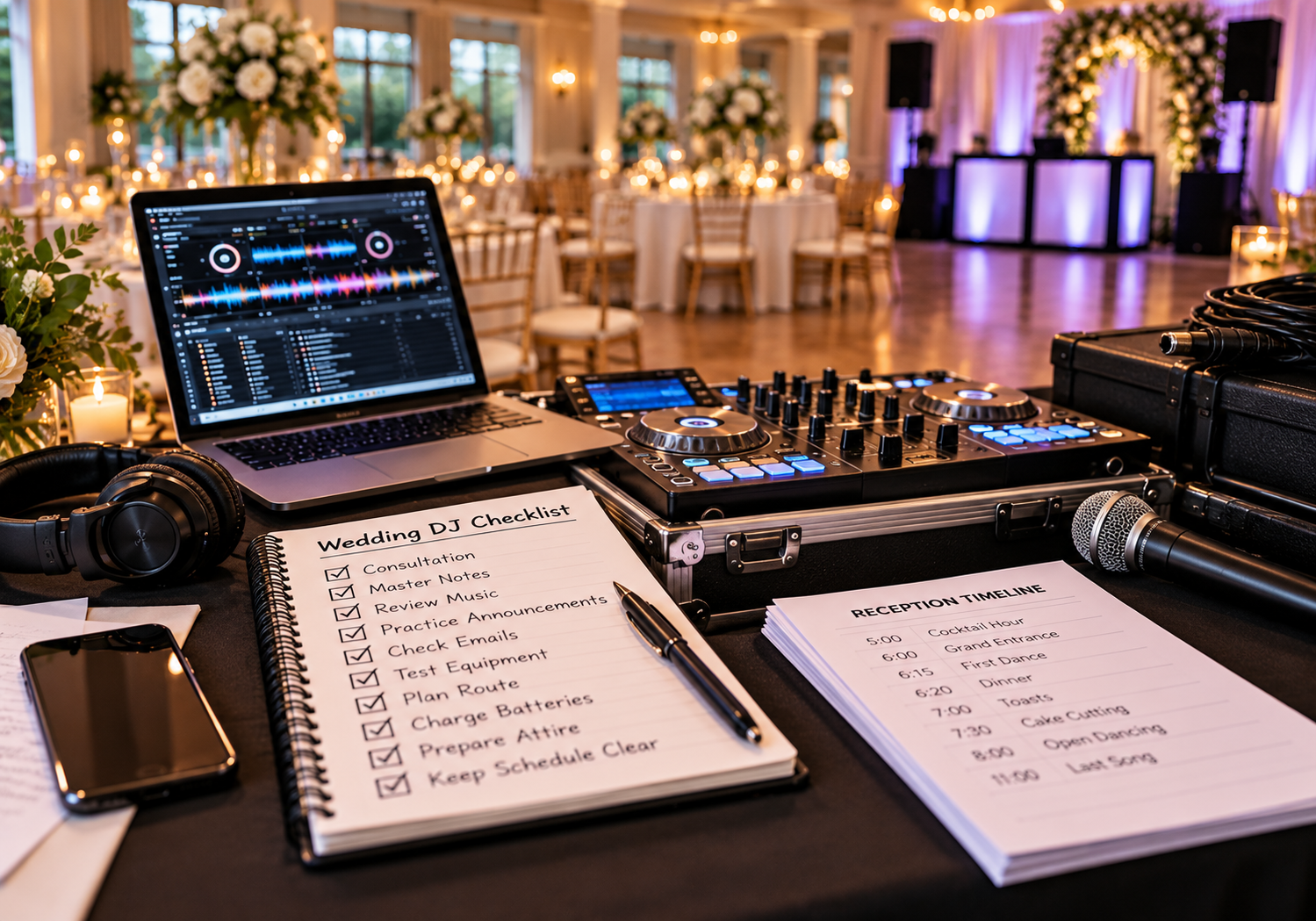
5. Review Your Emails and Text Messages From the Couple
Even after the consultation and questionnaire are complete, new information may arrive as the wedding approaches.
The couple might change a song, update the wedding party lineup, adjust the reception schedule, or ask a question about your services.
That is why checking your emails and text messages should be a standard part of your wedding preparation routine.
Review your recent communications carefully, especially during the final week before the event.
Look for updates involving:
- Changes to special dance songs.
- New or revised music requests.
- Adjustments to the grand entrance order.
- Changes to the reception timeline.
- Updated names or pronunciations.
- Requests for additional announcements.
- Questions about setup or arrival times.
- Information about unexpected surprises or special moments.
Do not rely on the assumption that the couple will contact you if something important changes.
Some couples are extremely busy during the final days of wedding planning. They may send an update without realizing that you have not yet reviewed it.
Make a habit of checking your messages and incorporating any confirmed changes into your master notes list.
If a message creates uncertainty, ask for clarification rather than making assumptions.
For example, if the couple sends a new song title without explaining whether it replaces an earlier selection or is an additional request, confirm which they prefer.
It is also helpful to respond to messages that require a response so the couple knows you received the information.
However, avoid making unnecessary changes to established plans without confirmation.
Your goal is to ensure that everyone is working from the same information.
A few minutes spent reviewing communications can prevent a last-minute misunderstanding and help the couple feel confident that their DJ is paying attention.
6. Inspect and Test All Your DJ Equipment Before Leaving
Your equipment is the foundation of your ability to perform.
Even if you used everything successfully at your previous event, you should inspect your gear before every wedding.
Equipment problems can happen unexpectedly. A cable can become damaged, a connector can loosen, or a device can develop an issue during transportation.
Testing your equipment ahead of time gives you an opportunity to identify and address problems before they affect the reception.
Start with your primary DJ system.
Depending on your setup, this may include:
- DJ controller or mixer.
- Laptop and DJ software.
- Main speakers.
- Subwoofer.
- Microphones.
- Wireless microphone receivers.
- Audio cables.
- Power cables and extension cords.
- Speaker stands.
- Backup music source.
- Ceremony audio equipment.
- Lighting equipment.
- Photo booth or other equipment included in your services.
Inspect cables for visible damage and make sure connectors fit securely.
Check that your speakers and subwoofers power on and produce clean audio. Listen for unusual buzzing, rattling, distortion, or other noises.
Test your microphones and confirm that their batteries are working.
Open your DJ software and verify that your music library loads correctly. Confirm that your controller communicates with your computer and that your audio output is working as expected.
If you provide ceremony sound or additional services, test that equipment separately.
Do not forget your backup equipment.
A spare cable, backup microphone, or alternate way to play music can save the day if your primary equipment develops a problem.
You should also verify that your power requirements and cable lengths are appropriate for the venue.
If the venue has specific restrictions involving electrical outlets, equipment placement, or sound levels, account for those requirements before loading your vehicle.
Finally, pack your equipment in an organized way so you can locate essential items quickly during setup.
Never assume your equipment is ready simply because it worked at the last wedding.
A brief inspection before every event is a small investment that can prevent a much larger problem.
Top 10 Steps For DJs Preparing for a Wedding – Continued
7. Check the Route to the Wedding Venue in Advance
Knowing where you are going is an important part of being a reliable wedding DJ.
It may seem simple, but arriving late because of traffic, construction, a wrong turn, or an unfamiliar venue entrance can create unnecessary stress.
Check the route to the venue before the wedding day.
Enter the complete address into your preferred navigation app and review the estimated travel time.
Pay attention to the location of the venue’s actual entrance. Some reception venues have multiple entrances, and the address used by guests may not be the best access point for vendors unloading equipment.
If necessary, contact the venue to ask where vendors should enter and where you can park while unloading.
Next, consider the expected traffic conditions.
A route that takes 30 minutes during a quiet weekday morning may take significantly longer on a Saturday afternoon.
Allow additional time for traffic, construction, parking, and unloading your equipment.
You should also review your planned departure time.
For example, if you need to arrive at 2:00 p.m. for setup, do not plan to leave home at 1:30 p.m. simply because the navigation app estimates a 25-minute drive.
That schedule leaves almost no room for unexpected delays.
Build a reasonable time buffer into your travel plan.
If the venue is unfamiliar, review the route visually before leaving. Knowing which highway exit to take or where to turn into the property can make the drive less stressful.
On the wedding day, check your navigation app again before departure for traffic updates or road closures.
Having the route planned in advance allows you to concentrate on driving safely and arriving on time.
Your goal should be to reach the venue with enough time to unload, set up, test your equipment, and resolve any unexpected issues before guests arrive.
8. Charge All Batteries Needed for Your DJ Equipment
Battery management is another detail that is easy to overlook until it becomes a problem.
Many wedding DJs use equipment that depends on rechargeable or replaceable batteries. If a battery runs out during an important announcement or performance, the consequences can be frustrating.
Before the wedding, identify every piece of equipment that requires battery power.
Depending on your setup, this may include:
- Wireless microphones.
- Wireless microphone transmitters.
- Wireless lighting fixtures.
- Rechargeable uplighting systems.
- Battery-powered speakers.
- Wireless audio transmitters and receivers.
- Other portable equipment used during the event.
Charge rechargeable batteries fully according to the manufacturer’s instructions.
Do not assume that a device has enough power simply because it was charged after the previous wedding.
Battery-powered equipment can lose charge during storage, and some devices may consume power while switched on or in standby mode.
For equipment that uses replaceable batteries, check their condition and bring spares.
It is also wise to inspect your battery chargers and charging cables to make sure they work properly.
Organize your batteries so you can distinguish fully charged units from depleted ones. A simple labeling system or separate storage compartments can help prevent confusion.
If you use wireless microphones, test them after charging and verify that the receivers are functioning correctly.
For longer events, consider how long each battery is expected to last and whether you have a practical way to replace or recharge it if necessary.
Always follow the manufacturer’s recommendations for charging, storage, and battery handling.
Finally, unplug and pack your chargers once everything is ready.
This helps ensure that you do not leave essential accessories behind when loading your vehicle.
Proper battery preparation gives you one less thing to worry about when the reception is underway.
9. Prepare Your Wedding DJ Attire the Night Before
Your appearance contributes to the overall impression you make as a professional wedding DJ.
Couples hire you not only to provide music and announcements but also to represent their event professionally.
That is why you should decide what you are going to wear before the wedding day.
Start by reviewing any dress code requirements provided by the couple or venue.
Some weddings call for a formal suit, while others may be appropriate for dress pants, a button-down shirt, and dress shoes.
Choose clothing that matches the event and allows you to perform your responsibilities comfortably.
Once you have selected your outfit, prepare everything the night before.
Check that your clothes are clean, pressed, and free of stains or damage.
Make sure your shoes are clean and comfortable enough for several hours of standing and moving around.
Gather all the accessories you need, including a belt, tie, jacket, or other items that complete your outfit.
If your work involves loading equipment outdoors or setting up in difficult conditions, consider how to protect your wedding attire during setup. You may need to wear comfortable work clothes while unloading and change before guests arrive.
Keep your planned outfit separate from your equipment and anything that could get it dirty.
It is also a good idea to prepare a backup shirt in case of spills or unexpected problems.
Think about the weather as well. An outdoor ceremony or reception may require an additional layer, while a hot summer wedding may call for breathable clothing.
Your goal is to arrive at the venue with everything ready so you do not have to search for clothing or rush through last-minute preparations.
Preparing your attire the night before helps you start the wedding day feeling organized and looking professional.
10. Keep Your Wedding Day Schedule Clear of Unnecessary Commitments
One of the best ways to prepare for a wedding is to avoid scheduling unrelated activities on the day of the event.
Wedding DJs have responsibilities that extend beyond playing music. You may need to load equipment, travel to the venue, set up your sound system, coordinate with other vendors, and prepare for the reception.
Adding unrelated commitments to the same day increases the chance that something will interfere with your schedule.
Whenever possible, keep your wedding day focused on the wedding.
Avoid scheduling unnecessary errands, appointments, personal projects, or other activities that could distract you or delay your departure.
For example, if you plan to spend the morning working on a home project that takes longer than expected, you could find yourself rushing to load your equipment or leaving later than planned.
Even a seemingly small interruption can create a chain reaction.
Instead, complete as many personal and business responsibilities as possible before the wedding day.
Prepare your equipment, organize your notes, charge your batteries, select your clothing, and confirm your travel plans in advance.
Give yourself a realistic schedule that includes time for eating, getting ready, loading your vehicle, and traveling to the venue.
You should also avoid unnecessary distractions that could affect your concentration.
The goal is not to spend the entire day worrying about the wedding. It is to remove avoidable complications so you can approach the event calmly and professionally.
If you run your own DJ business, this step becomes especially important when you are responsible for multiple events or other business operations.
Having a reliable preparation routine allows you to focus on the job in front of you.
Remember that your clients have invested significant time, money, and emotion into their wedding day.
They deserve a DJ who arrives prepared, focused, and ready to deliver.
Protecting your schedule is one of the simplest ways to help make that happen.
Top 10 Steps For DJs Preparing for a Wedding
How to Turn These Preparation Steps Into a Repeatable System
Following these 10 steps for one wedding is helpful. Turning them into a consistent system is even better.
Professional wedding DJs often work multiple events throughout the year. Without an organized preparation process, it becomes easy to overlook details when the schedule gets busy.
Consider creating a standard wedding preparation checklist that you use for every event.
Your checklist could include the following milestones:
One to two weeks before the wedding
- Confirm that the questionnaire and consultation are complete.
- Review the reception timeline and vendor information.
- Organize the master notes list.
- Prepare the music selections and special edits.
- Write and practice the grand entrance announcement.
Several days before the event
- Review recent emails and text messages.
- Confirm any outstanding details with the couple.
- Test the DJ equipment.
- Check the route and expected travel time.
- Verify any special venue requirements.
The night before the wedding
- Charge the required batteries.
- Prepare your clothing.
- Organize your notes and music playlists.
- Pack and inspect your equipment.
- Confirm your departure and arrival schedule.
On the wedding day
- Review your final notes.
- Check traffic before leaving.
- Avoid unnecessary commitments and distractions.
- Arrive with enough time to unload, set up, and test your equipment.
You can adapt this schedule to your business and the type of services you provide.
The important thing is to establish a process that does not depend entirely on memory.
A checklist allows you to work efficiently while maintaining the attention to detail that couples expect from a professional wedding DJ.
Over time, a consistent system can reduce stress, prevent avoidable mistakes, and help you deliver a more dependable experience at every event.
Top 10 Steps For DJs Preparing for a Wedding – FAQ
How Far in Advance Should a Wedding DJ Prepare for a Wedding?
A wedding DJ should begin preparation several weeks before the event, with the exact timeline depending on the complexity of the wedding. The questionnaire and consultation should be completed early enough to resolve questions, prepare the music, and coordinate with the venue or wedding planner. The final equipment check, battery charging, clothing preparation, and travel review should be completed before the wedding day.
What Should a Wedding DJ Include on a Wedding Preparation Checklist?
A wedding DJ preparation checklist should include the couple’s questionnaire, consultation notes, reception timeline, special song selections, grand entrance script, vendor contact information, and venue instructions. It should also cover equipment testing, microphone batteries, backup music, clothing, travel arrangements, and the planned arrival time. A checklist helps prevent important tasks from being overlooked.
Why Is a Wedding DJ Consultation Important?
A wedding DJ consultation allows the DJ and couple to review reception details, clarify musical preferences, discuss announcements, and confirm the event timeline. It also gives the DJ an opportunity to ask questions that may not have been addressed in the questionnaire. This communication helps establish expectations and reduces the risk of misunderstandings on the wedding day.
How Should a DJ Organize Wedding Reception Music?
A DJ should organize wedding reception music into clearly labeled playlists or categories based on the event timeline. These may include ceremony music, cocktail hour, dinner, grand entrance, special dances, and open dancing. The DJ should verify the correct song versions, review any requested edits, and make sure important selections and do-not-play requests are clearly identified.
Top 10 Steps For DJs Preparing for a Wedding
What Equipment Should a Wedding DJ Test Before an Event?
A wedding DJ should test the DJ controller or mixer, laptop, DJ software, speakers, subwoofer, microphones, audio cables, power cables, and any lighting or additional equipment required for the event. DJs should also check backup equipment and verify that all music files are accessible. Testing equipment before departure helps identify problems while there is still time to address them.
How Early Should a Wedding DJ Arrive at the Venue?
A wedding DJ should arrive early enough to unload, set up, test the equipment, and resolve unexpected issues before the scheduled start of their services. The required arrival time depends on the size of the setup, venue access restrictions, and whether the DJ is providing ceremony audio or additional services. DJs should confirm the setup deadline with the venue and planner rather than relying on a universal arrival time.
How Can a Wedding DJ Avoid Last-Minute Problems?
A wedding DJ can avoid many last-minute problems by maintaining a master notes list, reviewing messages from the couple, testing equipment, charging batteries, checking the travel route, and preparing clothing in advance. Keeping the wedding day free of unnecessary commitments also reduces the risk of distractions and delays. A consistent preparation checklist makes these tasks easier to manage.
Top 10 Steps For DJs Preparing for a Wedding
What Should a Wedding DJ Ask the Couple Before the Reception?
A wedding DJ should ask about the reception timeline, grand entrance order, special dance songs, musical preferences, do-not-play requests, important announcements, and any planned surprises. The DJ should also confirm name pronunciations, venue logistics, and any special expectations for the dance floor. Reviewing these details during a consultation helps ensure that the DJ understands the couple’s plans.
How Can Wedding DJs Improve Their Preparation Process?
Wedding DJs can improve their preparation process by using standardized questionnaires, master notes templates, music review procedures, equipment checklists, and event-day schedules. After each wedding, they can evaluate what worked well and identify any steps that should be added or improved. Over time, this approach creates a more efficient and reliable workflow.
Why Should Wedding DJs Avoid Scheduling Other Activities on the Wedding Day?
Wedding DJs should avoid unnecessary commitments on the wedding day because unexpected delays can interfere with loading, travel, setup, and sound checks. Keeping the schedule clear allows the DJ to focus on the event and arrive with enough time to prepare. Completing errands and other responsibilities beforehand reduces distractions and helps the DJ begin the event in a professional, organized manner.
Top 10 Steps For DJs Preparing for a Wedding
Conclusion: Preparation Is the Foundation of a Successful Wedding Reception
Being a great wedding DJ involves much more than knowing which songs to play. It requires organization, communication, technical preparation, and the ability to anticipate what might happen during an event.
Following these 10 preparation steps helps you approach each wedding with a clear plan.
By consulting with the couple, maintaining a master notes list, reviewing your music, practicing your announcements, checking communications, testing equipment, planning your route, charging batteries, preparing your attire, and protecting your schedule, you can reduce unnecessary stress and avoid many preventable mistakes.
The goal is to arrive at the venue ready to perform, with the important details already handled.
The more prepared you are before the wedding, the more attention you can give to the couple and their guests during the reception.
Develop a preparation routine that works for your business, use it consistently, and make improvements whenever you identify an opportunity.
A well-prepared DJ is better equipped to handle unexpected changes, coordinate with other vendors, and deliver the professional experience couples expect on one of the most important days of their lives.
Top 10 Steps For DJs Preparing for a Wedding
Looking for wedding planning inspiration?
Explore some of our most popular guides for wedding planning.
The Ultimate Wedding Planning Guide, Wedding Planning Tips and Checklist, Wedding Timeline Guide, Wedding Budget Breakdown, What order do I pick my wedding vendors?, How to pick the perfect wedding DJ
CC King Entertainment
Indoor and Outdoor Weddings


Leave a Reply